HDTS Leadership
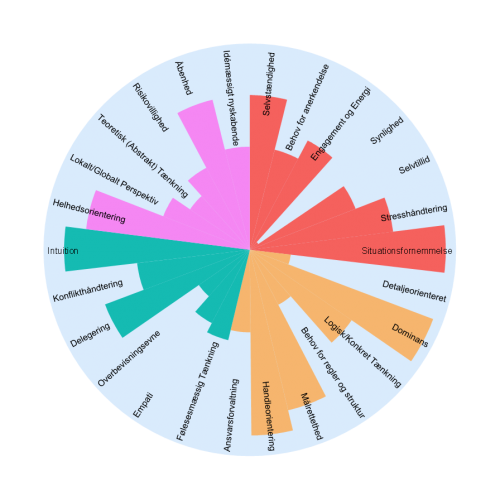 |
HDTS Leadership is designed to analyze and develop personal leadership. The overall test result is divided into 4 main areas with a total of 26 scales. |
The 4 main areas describe the personal strength as well as the 3 leadership roles that every good manager must master to varying degrees depending on the level of management you are at.
Personal strength and the 3 leadership roles:
- Controller
- Inspirator
- Strategist
 |
1. Personal Strength Personal strength is the starting point of all management, and these characteristics are used regardless of the manager's job content. The manager needs good autonomy and a forward drive. With a balanced need for recognition, a great commitment and energy, the manager can spread motivation among the employees. With a well-developed situational awareness and self-confidence, the manager can find his personal "True North" and thus appear as a resourceful leader. If the personal strength in overall good balance is good, the manager will often appear with a natural authenticity, which is a central leadership property. |
 |
2. Controller These properties are primarily used to turn goals into results. The controller makes the necessary decisions in day-to-day operations and the wheels are kept running to ensure that the business requirements are met. The controller shall ensure compliance with rules, there must be a willingness to lead with the ability to achieve the objectives, as well as sound personal responsibility management and action orientation combined with an appropriate attention to detail. |
 |
3. Inspirator The inspirator uses his intuition as a natural resource, and the inspirator has a good situational awareness that helps develop good relationships and highly motivated employees. The inspirator has good conviction, so employees will want to try new challenges. Many crises are solved with the inspirator's insight into people and the underlying motives. The inspirator builds good relationships through his empathy, and the desire and ability to delegate is well developed. He/she knows that success for employees is the success of the organization. The inspirator creates meaning and passion in the job for all employees. |
 |
4. Strategist As a strategist, the manager uses his analytical overview, but not least his intuition and openness to new directions. The strategist creates the framework for change. Creativity and the ability to innovate are important here, and the strategist is open to innovation. The strategist thinks predominantly in large wholes and sees almost everything in a helicopter perspective from high altitude, and not least so dare the strategist take the necessary risks. The strategist is ready for change and is often at the forefront of development. |
Executive and management recruitment
The personality test increases the chance of finding the right candidate in recruitments and helps avoid mis-employment, because the result provides a thorough insight into the job candidate's resources and development areas in relation to the job profile. This ensures match in relation to tasks, workplace culture, immediate manager and colleagues.
Gain insight into many different competencies, such as:
- Emotional and social competence
- Leadership competence
- Planning
- Resilience
- Flexibility
- Team collaboration
- Innovative capacity
- Political beating
- Sales focus
Executive and manager coaching
As change takes hold in the workplace, there is a need for managers at the different levels of management to develop new skills. HDTS Leadership provides insight into personal strengths and development potentials. Through targeted coaching based on the test result, relevant personal competencies can be developed.
Leadership team development
A successful high performance management team is characterized by its ability to communicate and collaborate around common tasks and projects. This presupposes that the members of the management team have different complementary competencies and are able to perform different psychological team roles. HDTS Leadership provides insight into the team's strengths and potential challenges and can be used, among other things, to optimize work processes, strengthen team management, communication and collaboration.